
Review
Abstract
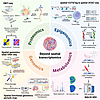
Coordinated changes in gene expression, epigenetic regulation, protein and metabolic activities together drive disease progression and determine clinical outcomes. While spatially resolved transcriptomics has been widely adopted across biomedical fields, it offers an incomplete picture limited to transcriptomic levels. Here, we survey the latest developments in spatial multiomics technologies, with particular emphasis on platforms that extend beyond conventional transcriptomics and profile genomics, epigenomics, proteomics, or metabolomics within intact tissues. These approaches are rapidly becoming commercialized, and here we highlight major technical breakthroughs, enhanced sample compatibility, emerging applications, and computational tools for data analysis. This Review aims to equip researchers with a clear understanding of the current technological landscape and to accelerate the adoption of spatial multiomics methods in biomedical research.
Authors
Xinchen Mao, Zhuo Chen, Emily J. Hwang, Jun Liu, Junrou Huang, Haikuo Li
Abstract
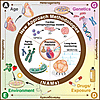
Aging is a major contributor to cardiovascular disease and mortality in older adults. Yet most preclinical and experimental cardiac studies fail to account for age as a primary biological variable, leaving a critical gap in our understanding of how aging contributes to disease progression. Bridging this gap requires integrating aging biology, cardiac pathophysiology, and cutting-edge biotechnology to uncover the mechanisms underlying age-related cardiac dysfunction. We offer a new approach methodologies (NAMs) perspective on how emerging bioengineering strategies may reshape the study of cardiac aging by enabling multidimensional monitoring of cardiac function, aging trajectories, and therapeutic responses. To capture this complexity, we propose the A×G×E×D framework, where A stands for age, G for genetics, E for environment, and D for drug exposure, as a multidimensional lens for understanding how these factors converge to determine cardiac vulnerability during aging. We highlight the integration of long-term cardiac microtissues with advancements in biotechnology to model age. This Perspective opens new frontiers for understanding how A×G×E×D interactions manifest at the molecular, cellular, and electrophysiological levels and for designing responsive, personalized interventions that align with each individual’s evolving physiology. By developing robust bioengineered platforms that recapitulate human cardiac aging, we can advance toward precision geromedicine for cardiovascular health.
Authors
Kritika Chaddha, Mabel Bartlett, Tzahi Cohen-Karni, Aditi Gurkar
Abstract
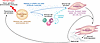
Organ fibrosis involves a complex interplay between diverse cell types and signaling pathways that ultimately leads to the pathologic accumulation of excessive extracellular matrix, subsequently resulting in organ dysfunction. In recent years, the first drugs for the treatment of idiopathic pulmonary fibrosis have been approved; however, there is a major unmet need for effective antifibrotic therapies across organs. Despite the complexity of the fibrotic process in different tissues, certain features are shared and may form the basis for future therapeutic strategies. This Review will highlight these shared characteristics, cell states, and signaling pathways across organs with the goal of highlighting potential antifibrotic strategies.
Authors
Benjamin D. Humphreys

Abstract
Fibrosis is a major cause of mortality and morbidity worldwide with limited therapeutic options. Our understanding of fibrosis has significantly improved and led to the identification of “core” fibrogenic mechanisms that fuel a self-sustaining vicious cycle following the initial insult. The fibrotic niche is the result of complex cellular and molecular interactions that need to be disrupted to achieve transformational therapies. In this Review, we describe the current understanding of fibrogenic mechanisms, the progress and limitations of omics approaches in the identification of novel fibrotic pathways, and advances in therapeutic modalities that all together have the potential to unleash innovative cross-organ antifibrotic therapies.
Authors
Cynthia Lebeaupin, Katelyn L. Donahue, Ken Dower, Thomas A. Wynn, Kevin M. Hart, Thomas Fabre

Abstract
Fibrosis affects almost all organ systems, resulting in a dysfunctional extracellular matrix that impairs function and can lead to failure. Crosstalk between immune cells and the stromal environment exacerbates fibrosis in all organs and is an attractive therapeutic target. Here, we discuss recent findings regarding the cellular and molecular mechanisms that underlie inflammation and fibrosis across organs. We focus on how reciprocal immune/stromal signaling maintains fibrotic niches, outline strategies for therapeutic intervention beyond current antifibrotic agents, and highlight the bone marrow fibrotic disease myelofibrosis as a model for understanding, and ultimately reversing, fibrosis in human disease.
Authors
Lucas Greven, Stijn N.R. Fuchs, Hélène F.E. Gleitz, Rebekka K. Schneider

Abstract
The ECM is a dynamic component of the tumor microenvironment with a critical role in cancer progression, invasion, metastasis, immune exclusion, and response to therapy. Recent advances in proteomic analyses investigating the insoluble ECM fractions (termed “matrisome analysis”), along with single-cell RNA sequencing and spatial transcriptomics, have revealed cancer-specific patterns of ECM remodeling. These studies have identified a panel of recurrently upregulated ECM proteins, including annexin A1, fibrillin-1, fibronectin, periostin, and tenascin-C, actively contributing to tumor growth, invasion, angiogenesis, and immune exclusion. The expression of the cancer-associated ECM is largely driven by cancer-associated fibroblasts (CAFs), whose molecular diversity has been dissected through single-cell profiling and consolidated in emerging CAF atlases across cancers. By investigating the matrisome composition and CAF heterogeneity, these studies have unraveled the pivotal role of the stroma in shaping tumor biology. Based on these discoveries, ECM proteins and CAFs are now being explored as biomarkers and therapeutic targets. Future integration of multi-omics datasets with clinical outcomes will help to translate these insights into novel biomarkers for patient stratification and stroma-directed therapeutic interventions.
Authors
Romain Desert, Orlando Musso, Thomas F. Baumert
Abstract
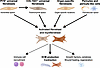
As the principal ECM-producing cell type, fibroblasts are essential regulators of tissue architecture and function in development, homeostasis, and disease. While their disease-promoting functions in fibrosis have long been the center of attention, it is increasingly recognized that fibroblasts exert critical homeostatic roles across organs, acting as sentinels that regulate the function, proliferation, and recruitment of epithelial, endothelial and immune cells in health and disease. Here, we will review the roles of fibroblasts and fibroblast-like cells in tissue maintenance, physiological wound healing, regeneration, maladaptive fibrosis, and cancer across major organs, including the skin, lung, liver, intestine, and kidney, and highlight organ-specific and shared populations and functions. We will discuss the role of PI16+ and COL15A1+ universal fibroblasts, organ-specific fibroblasts, and pericyte and pericyte-like stellate cells as cellular sources for the majority of CTHRC1+ activated fibroblasts and αSMA+ or LRRC15+ myofibroblasts and highlight the functions of specialized subpopulations, such as inflammatory fibroblasts, antigen-presenting fibroblasts, and fibroblast-like cells, including mesothelial and smooth muscle cells. A refined understanding of fibroblast heterogeneity holds promise for novel therapeutic concepts, aimed at targeting pathogenic subpopulations while preserving or enhancing homeostatic functions.
Authors
Xiaochun Yang, Marcella Steffani, Sandeep Nadella, Dean Sheppard, Florian Rieder, Yuval Rinkevich, Rafael Kramann, David A. Tuveson, Robert F. Schwabe
Abstract
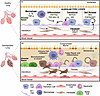
The oxygen-rich milieu of the lungs necessitates precise iron homeostasis and regulation, processes that are fundamental to pulmonary physiology but often receive limited attention. However, in recent years, dysregulation of iron homeostasis has been linked to numerous acute and chronic respiratory diseases. Here, we comprehensively evaluate the mechanisms governing iron homeostasis in the alveolar epithelium of the lung and examine how iron dysregulation contributes to impaired alveolar epithelial repair in respiratory disease. This Review focuses on the effects of iron on alveolar epithelial cell homeostasis and repair and disease pathogenesis. There will be a focus on emerging interventions designed to reestablish iron homeostasis and their potential therapeutic implications related to enhancing lung repair and limiting the progression of lung disease.
Authors
Ugonna Mbaekwe, Sarah Kenny, Suzanne M. Cloonan, Corrine R. Kliment
Abstract
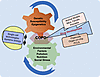
Chronic obstructive pulmonary disease (COPD) was the third leading cause of global mortality in 2011 but receives limited attention and research funding. This Review describes the current knowledge on COPD risk factors, including genetic and epigenetic determinants and their interactions with the microbiome and environmental exposures. Preclinical models are being refined and single-cell transcriptomic, metabolomic, and proteomic technologies are being implemented to investigate the molecular mechanisms of disease progression. Patient cohorts to define biomarkers of early disease and the latest approaches to diagnose pre-COPD are essential to accelerate the development of novel and effective therapeutic interventions and translate new findings into clinical trials. This Review is a summary of topics covered by a symposium organized by the COPD-iNET consortium, an international network of researchers who have established a platform that facilitates collaboration of this multidisciplinary group of preclinical, translational, and clinical researchers.
Authors
Yohannes Tesfaigzi, Ali Önder Yildirim, Francesca Polverino, Thomas M. Conlon, Venkataramana Sidhaye, Maor Sauler, S. Vamsee Raju, Renata Z. Jurkowska, Divay Chandra, Michael H. Cho, Edwin K. Silverman, Ramon C. Sun, Peter Castaldi, Purushothama Rao Tata, Kambez H. Benam, Linto Antony, Mareike Lehmann, Beata Kosmider, Karim Bahmed, Zerihun H. Negasi, Kamakshi Bankoti, Carter Swaby, Dave A. Lagowala, Yeşim Vural, Hasan Bayram, Rosa Faner, George Washko, Dinh Son Bui, Bartolome Celli, Roxana Maria Wasnick, Enid Neptune
Abstract
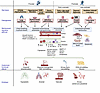
Bronchopulmonary dysplasia (BPD) remains a debilitating disease in premature infants. The chronic pathogenesis of BPD with complex prenatal and postnatal programming challenges attempts at precisely defining or treating disease. While existing BPD definitions categorize disease severity, a lack of consideration of disease heterogeneity and endotypes has contributed to the failure of clinical trials to improve BPD outcomes. Recent studies have used advanced lung imaging techniques, echocardiography, and lung function tests to identify airway, parenchymal, and vascular BPD endotypes. These endotypes carry different prognoses and require endotype-specific treatment strategies to optimize infant outcomes. In this Review, we focus on the pathogenic mechanisms that specify individual BPD endotypes and discuss how combining biomarkers, functional studies, and artificial intelligence–based characterization of endotypes can inform precision therapies for BPD.
Authors
Megha Sharma, Gangaram Akangire, Noah H. Hillman, Winston M. Manimtim, Mark Ivan Attard, Venkatesh Sampath
No posts were found with this tag.


