
Submit a comment
Abstract
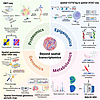
Coordinated changes in gene expression, epigenetic regulation, protein and metabolic activities together drive disease progression and determine clinical outcomes. While spatially resolved transcriptomics has been widely adopted across biomedical fields, it offers an incomplete picture limited to transcriptomic levels. Here, we survey the latest developments in spatial multiomics technologies, with particular emphasis on platforms that extend beyond conventional transcriptomics and profile genomics, epigenomics, proteomics, or metabolomics within intact tissues. These approaches are rapidly becoming commercialized, and here we highlight major technical breakthroughs, enhanced sample compatibility, emerging applications, and computational tools for data analysis. This Review aims to equip researchers with a clear understanding of the current technological landscape and to accelerate the adoption of spatial multiomics methods in biomedical research.
Authors
Xinchen Mao, Zhuo Chen, Emily J. Hwang, Jun Liu, Junrou Huang, Haikuo Li
Guidelines
The Editorial Board will only consider comments that are deemed relevant and of interest to readers. The Journal will not post data that have not been subjected to peer review; or a comment that is essentially a reiteration of another comment.
- Comments appear on the Journal’s website and are linked from the original article’s web page.
- Authors are notified by email if their comments are posted.
- The Journal reserves the right to edit comments for length and clarity.
- No appeals will be considered.
- Comments are not indexed in PubMed.
Specific requirements
- Maximum length, 400 words
- Entered as plain text or HTML
- Author’s name and email address, to be posted with the comment
- Declaration of all potential conflicts of interest (even if these are not ultimately posted); see the Journal’s conflict-of-interest policy
- Comments may not include figures


