
Submit a comment
Abstract
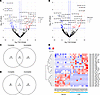
Spinal cord injury (SCI) leads to severe neurological and functional impairments, yet reliable biomarkers for assessing injury severity and predicting recovery remain limited. Cerebrospinal fluid (CSF) is in direct contact with the central nervous system and provides a valuable source for detecting molecular changes after SCI. Although exosomal microRNAs (miRNAs) and proteins are increasingly recognized as mediators of intercellular communication, the role of human CSF exosomes in SCI has not been systematically investigated. To identify exosome-based biomarkers and potential therapeutic targets, we analyzed CSF and serum exosomes from patients with acute SCI using RNA sequencing and proteomic profiling. Weighted gene co-expression network analysis identified 6 gene modules significantly associated with injury severity and neurological recovery at 3 months. Proteomic analysis revealed a 5-protein panel that distinguished complete from incomplete SCI and a 4-protein panel that predicted neurological improvement. Additionally, 15 CSF-specific and 9 serum-specific exosomal miRNAs were identified independent of injury severity. Among 10 tested miRNAs associated with neurological recovery, 7 regulated astrocyte proliferation, and 6 promoted neurite extension and synapse formation. Overall, this study provides a comprehensive characterization of CSF exosomal miRNAs and proteins in human SCI and identifies molecular signatures associated with injury severity and recovery.
Authors
Dallas L. Sheinberg, Haichao Wei, Joseph S. Withrow, Farshad Homayouni Moghadam, Chia-Chen Lu, Jyotirmoy Rakshit, Jennifer Zaragoza, John R. Williams, Wen Li, Jacques J. Morcos, Jia Qian Wu
Guidelines
The Editorial Board will only consider comments that are deemed relevant and of interest to readers. The Journal will not post data that have not been subjected to peer review; or a comment that is essentially a reiteration of another comment.
- Comments appear on the Journal’s website and are linked from the original article’s web page.
- Authors are notified by email if their comments are posted.
- The Journal reserves the right to edit comments for length and clarity.
- No appeals will be considered.
- Comments are not indexed in PubMed.
Specific requirements
- Maximum length, 400 words
- Entered as plain text or HTML
- Author’s name and email address, to be posted with the comment
- Declaration of all potential conflicts of interest (even if these are not ultimately posted); see the Journal’s conflict-of-interest policy
- Comments may not include figures


