
Research LetterCell biologyPulmonology
Open Access |  10.1172/jci.insight.206375
Basal cell transplantation supports multilineage differentiation and restores CFTR function in ex vivo ferret airways
Kadambari Vijaykumar,1 Liang Ma,2 Kevin Chen,2 Liping Tang,1 Nikoleta Pavelkova,1 Elex Harris,1 Kajal Jadhav,1 Qian Li,1 Mohamed Hanafy,1 Hinnerk Schulz-Hildebrandt,3 Guillermo J. Tearney,3 Finn Hawkins,2 Darrell N. Kotton,2 and Steven M. Rowe1
1Department of Medicine and Gregory Fleming James Cystic Fibrosis Research Center, University of Alabama at Birmingham, Birmingham, Alabama, USA.
2Center for Regenerative Medicine, Boston Medical Center, Boston, Massachusetts, USA.
3Wellman Center for Photomedicine, Massachusetts General Hospital, Boston, Massachusetts, USA.
Address correspondence to: Steven M. Rowe, 1918 University Boulevard, MCLM 824, Birmingham, Alabama, 35294, USA. Phone: 205.934.9640; Email: smrowe@uab.edu.
Find articles by Vijaykumar, K. in: PubMed | Google Scholar
1Department of Medicine and Gregory Fleming James Cystic Fibrosis Research Center, University of Alabama at Birmingham, Birmingham, Alabama, USA.
2Center for Regenerative Medicine, Boston Medical Center, Boston, Massachusetts, USA.
3Wellman Center for Photomedicine, Massachusetts General Hospital, Boston, Massachusetts, USA.
Address correspondence to: Steven M. Rowe, 1918 University Boulevard, MCLM 824, Birmingham, Alabama, 35294, USA. Phone: 205.934.9640; Email: smrowe@uab.edu.
Find articles by Ma, L. in: PubMed | Google Scholar
1Department of Medicine and Gregory Fleming James Cystic Fibrosis Research Center, University of Alabama at Birmingham, Birmingham, Alabama, USA.
2Center for Regenerative Medicine, Boston Medical Center, Boston, Massachusetts, USA.
3Wellman Center for Photomedicine, Massachusetts General Hospital, Boston, Massachusetts, USA.
Address correspondence to: Steven M. Rowe, 1918 University Boulevard, MCLM 824, Birmingham, Alabama, 35294, USA. Phone: 205.934.9640; Email: smrowe@uab.edu.
Find articles by Chen, K. in: PubMed | Google Scholar
1Department of Medicine and Gregory Fleming James Cystic Fibrosis Research Center, University of Alabama at Birmingham, Birmingham, Alabama, USA.
2Center for Regenerative Medicine, Boston Medical Center, Boston, Massachusetts, USA.
3Wellman Center for Photomedicine, Massachusetts General Hospital, Boston, Massachusetts, USA.
Address correspondence to: Steven M. Rowe, 1918 University Boulevard, MCLM 824, Birmingham, Alabama, 35294, USA. Phone: 205.934.9640; Email: smrowe@uab.edu.
Find articles by Tang, L. in: PubMed | Google Scholar
1Department of Medicine and Gregory Fleming James Cystic Fibrosis Research Center, University of Alabama at Birmingham, Birmingham, Alabama, USA.
2Center for Regenerative Medicine, Boston Medical Center, Boston, Massachusetts, USA.
3Wellman Center for Photomedicine, Massachusetts General Hospital, Boston, Massachusetts, USA.
Address correspondence to: Steven M. Rowe, 1918 University Boulevard, MCLM 824, Birmingham, Alabama, 35294, USA. Phone: 205.934.9640; Email: smrowe@uab.edu.
Find articles by Pavelkova, N. in: PubMed | Google Scholar
1Department of Medicine and Gregory Fleming James Cystic Fibrosis Research Center, University of Alabama at Birmingham, Birmingham, Alabama, USA.
2Center for Regenerative Medicine, Boston Medical Center, Boston, Massachusetts, USA.
3Wellman Center for Photomedicine, Massachusetts General Hospital, Boston, Massachusetts, USA.
Address correspondence to: Steven M. Rowe, 1918 University Boulevard, MCLM 824, Birmingham, Alabama, 35294, USA. Phone: 205.934.9640; Email: smrowe@uab.edu.
Find articles by Harris, E. in: PubMed | Google Scholar
1Department of Medicine and Gregory Fleming James Cystic Fibrosis Research Center, University of Alabama at Birmingham, Birmingham, Alabama, USA.
2Center for Regenerative Medicine, Boston Medical Center, Boston, Massachusetts, USA.
3Wellman Center for Photomedicine, Massachusetts General Hospital, Boston, Massachusetts, USA.
Address correspondence to: Steven M. Rowe, 1918 University Boulevard, MCLM 824, Birmingham, Alabama, 35294, USA. Phone: 205.934.9640; Email: smrowe@uab.edu.
Find articles by Jadhav, K. in: PubMed | Google Scholar
1Department of Medicine and Gregory Fleming James Cystic Fibrosis Research Center, University of Alabama at Birmingham, Birmingham, Alabama, USA.
2Center for Regenerative Medicine, Boston Medical Center, Boston, Massachusetts, USA.
3Wellman Center for Photomedicine, Massachusetts General Hospital, Boston, Massachusetts, USA.
Address correspondence to: Steven M. Rowe, 1918 University Boulevard, MCLM 824, Birmingham, Alabama, 35294, USA. Phone: 205.934.9640; Email: smrowe@uab.edu.
Find articles by Li, Q. in: PubMed | Google Scholar
1Department of Medicine and Gregory Fleming James Cystic Fibrosis Research Center, University of Alabama at Birmingham, Birmingham, Alabama, USA.
2Center for Regenerative Medicine, Boston Medical Center, Boston, Massachusetts, USA.
3Wellman Center for Photomedicine, Massachusetts General Hospital, Boston, Massachusetts, USA.
Address correspondence to: Steven M. Rowe, 1918 University Boulevard, MCLM 824, Birmingham, Alabama, 35294, USA. Phone: 205.934.9640; Email: smrowe@uab.edu.
Find articles by Hanafy, M. in: PubMed | Google Scholar
1Department of Medicine and Gregory Fleming James Cystic Fibrosis Research Center, University of Alabama at Birmingham, Birmingham, Alabama, USA.
2Center for Regenerative Medicine, Boston Medical Center, Boston, Massachusetts, USA.
3Wellman Center for Photomedicine, Massachusetts General Hospital, Boston, Massachusetts, USA.
Address correspondence to: Steven M. Rowe, 1918 University Boulevard, MCLM 824, Birmingham, Alabama, 35294, USA. Phone: 205.934.9640; Email: smrowe@uab.edu.
Find articles by Schulz-Hildebrandt, H. in: PubMed | Google Scholar
1Department of Medicine and Gregory Fleming James Cystic Fibrosis Research Center, University of Alabama at Birmingham, Birmingham, Alabama, USA.
2Center for Regenerative Medicine, Boston Medical Center, Boston, Massachusetts, USA.
3Wellman Center for Photomedicine, Massachusetts General Hospital, Boston, Massachusetts, USA.
Address correspondence to: Steven M. Rowe, 1918 University Boulevard, MCLM 824, Birmingham, Alabama, 35294, USA. Phone: 205.934.9640; Email: smrowe@uab.edu.
Find articles by Tearney, G. in: PubMed | Google Scholar
1Department of Medicine and Gregory Fleming James Cystic Fibrosis Research Center, University of Alabama at Birmingham, Birmingham, Alabama, USA.
2Center for Regenerative Medicine, Boston Medical Center, Boston, Massachusetts, USA.
3Wellman Center for Photomedicine, Massachusetts General Hospital, Boston, Massachusetts, USA.
Address correspondence to: Steven M. Rowe, 1918 University Boulevard, MCLM 824, Birmingham, Alabama, 35294, USA. Phone: 205.934.9640; Email: smrowe@uab.edu.
Find articles by Hawkins, F. in: PubMed | Google Scholar
1Department of Medicine and Gregory Fleming James Cystic Fibrosis Research Center, University of Alabama at Birmingham, Birmingham, Alabama, USA.
2Center for Regenerative Medicine, Boston Medical Center, Boston, Massachusetts, USA.
3Wellman Center for Photomedicine, Massachusetts General Hospital, Boston, Massachusetts, USA.
Address correspondence to: Steven M. Rowe, 1918 University Boulevard, MCLM 824, Birmingham, Alabama, 35294, USA. Phone: 205.934.9640; Email: smrowe@uab.edu.
Find articles by
Kotton, D.
in:
PubMed
|
Google Scholar
|

1Department of Medicine and Gregory Fleming James Cystic Fibrosis Research Center, University of Alabama at Birmingham, Birmingham, Alabama, USA.
2Center for Regenerative Medicine, Boston Medical Center, Boston, Massachusetts, USA.
3Wellman Center for Photomedicine, Massachusetts General Hospital, Boston, Massachusetts, USA.
Address correspondence to: Steven M. Rowe, 1918 University Boulevard, MCLM 824, Birmingham, Alabama, 35294, USA. Phone: 205.934.9640; Email: smrowe@uab.edu.
Find articles by
Rowe, S.
in:
PubMed
|
Google Scholar
|
Published August 18, 2026 - More info
JCI Insight. 2026;11(19):e206375. https://doi.org/10.1172/jci.insight.206375.
© 2026 Vijaykumar et al. This work is licensed under the Creative Commons Attribution 4.0 International License. To view a copy of this license, visit http://creativecommons.org/licenses/by/4.0/.

To the Editor: Cell-based therapies offer a mutation-agnostic approach to restoring airway function in cystic fibrosis (CF), overcoming limitations of genotype-specific modulators (1). Basal cells are central to airway repair (2) owing to their capacity for self-renewal and multilineage differentiation (3). While basal cells have durably reconstituted rodent airway epithelium (4), functional disease rescue following cell engraftment has not been shown. To enable in vivo translation, proof-of-concept testing in models that recapitulate CF pathophysiology is essential. Here, we utilized ferret bronchial epithelial cells (FBECs) in what we believe to be novel in vitro and ex vivo systems to define technical and physiological benchmarks for cellular reconstitution.
-
In vitro injury and rescue
Primary FBECs from WT and CF G551D ferrets were harvested by bronchoscopy, expanded, and differentiated at air-liquid interface (ALI). WT FBECs were treated with polidocanol (PDOC) to generate a permissive cell niche. Epithelial integrity was monitored via transepithelial electrical resistance (TEER), trypan blue viability assays, and microscopy. The highest concentrations of PDOC (0.125% and 0.25%) caused the highest degree of cell death. Conversely, 0.03% and 0.05% PDOC maintained high viability (77%–81%) but insufficient niche generation for cell implantation (TEER drop <50% at 60 minutes). 0.1% PDOC yielded approximately 59% live cells, with 95% TEER drop balancing niche generation with cell viability, compared to 0.04% PDOC required to restore barrier integrity in human cells (5).
Injury kinetics of 0.1% PDOC were similar between WT and CF G551D ALI cultures (n = 9 each) with rapid decline in TEER over 30 minutes. In WT cells, baseline TEER (2,200–3,000 Ω × cm2) decreased (to <400 Ω × cm2) within 20 minutes of PDOC exposure, which returned to baseline by day 12. CF G551D cells had lower baseline TEER (~1,400 Ω × cm2) but showed similar TEER decline and recovery (Figure 1A). These results confirm that 0.1% PDOC generates a permissive niche without hindering regeneration.
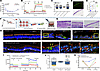 Figure 1
Functional reconstitution of ferret airway epithelium following basal cell transplantation. (A–E) In vitro assessment. (A) Transepithelial electrical resistance (TEER) with decline of barrier integrity following 0.1% polidocanol (PDOC) exposure and recovery following implantation. (B) Using chamber traces of WT and CFG551D FBECs 4 weeks after injury and GFP+ cell implantation. (C) Change in short-circuit current (ΔIsc) after forskolin with CFTR functional rescue in transplanted CF cultures (P = 0.0024). (D) Fluorescent microscopy confirms incorporation of GFP+ donor cells into epithelium. Scale bars: 50 μm. (E) Micro-optical coherence tomography (μOCT) shows improvement in mucociliary transport in transplanted CF cultures (P = 0.0005). (F–K) Ex vivo tracheal engraftment. (F) FBEC harvest, expansion, and transplant protocol. (G) H&E staining showing intact ciliation in untreated control (left) compared with ciliary loss and basal cell exposure with injury (middle) and evidence of differentiation after transplant (right). Scale bars: 100 μm. (H) Immunofluorescence microscopy showing GFP+ cell engraftment (middle and right, top row) 3 weeks after transplant compared with controls (left, top and bottom row). GFP+ FBECs differentiate into ciliated (second image, bottom row, yellow arrows, GFP+AT+), secretory (third image, bottom row, orange arrow, MUC5B only; last image, bottom row, costained with GFP and MUC5B), and basal cells (last image, bottom row, white arrow, KRT5+GFP+). (I) Isc responses under chloride secretory gradient conditions and (J) summary data (ΔIsc, n = 4) with recovery of CFTR function in engrafted tissue (P = 0.038). (K) μOCT showing improved ciliary beat frequency in transplanted tissue (P = 0.0049). Data presented as mean ± SD. Statistical significance determined using 1-way ANOVA: *P < 0.05; **P ≤ 0.01; ***P ≤ 0.001.
To evaluate functional rescue, early passage WT FBECs were GFP labeled by lentiviral transduction and then delivered (1.5 × 10⁵ cells in 100 μL PneumaCult-EX Plus media) onto CF G551D-differentiated cultures 30 minutes after 0.1% PDOC. At 4 weeks, fluorescence microscopy (Figure 1D) and micro-optical coherence imaging confirmed engraftment, comprising about 77% of epithelium. Short-circuit current (Isc) analysis by Ussing at 4 weeks after implantation confirmed CF transmembrane conductance regulator (CFTR) rescue in CF cultures with WT transplantation, restoring forskolin responsiveness (mean ΔIsc ± SD, after forskolin 121.5 ± 10.1 μA/cm2, after CFTRInh-172/GlyH101 –84.8 ± 0.9 μA/cm2) compared with PDOC-only (7.9 ± 2.6 μA/cm2 after forskolin, P < 0.004; 8.5 ± 1.8 μA/cm2 after CFTRInh-172/GlyH-101, P < 0.0004) and WT PDOC controls (82.1 ± 7.4 μA/cm2 after forskolin, 67.9 ± 9.5 after CFTRInh-172/GlyH-101; n = 3/condition) (Figure 1, B and C). WT to CF transplant FBECs showed significant improvement in mucociliary transport (MCT; mean ± SD, 1.2 ± 0.1 mm/min), comparable to WT to WT transplant controls (1.1 ± 0.5 mm/min) (Figure 1E). Collectively, these data indicate successful rescue of CFTR function and mucus transport in CF G551D FBECs through implantation of WT cells.


