
Abstract
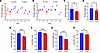
Prader-Willi syndrome (PWS) is a complex genetic disorder resulting from the deficiency of several maternally imprinted genes, including SNORD116, in the 15q11-q13 region. Loss of Snord116 in mice recapitulates some of the most salient clinical features of PWS, including growth hormone (GH) deficiency and hypogonadism. This study explored the impact of Snord116 deficiency on early postnatal pituitary development and growth in Snord116-KO mice. Snord116 was found to be expressed in both the anterior and posterior pituitary. Pituitary transcriptomes of Snord116-KO and WT mice at 2 developmental stages, P0 and 4 weeks of age, were interrogated and related to ex vivo analyses of GH secretion in the pituitaries of 5-week-old mice. Significant differences in pituitary transcriptomes were detected between Snord116-KO and WT mice at 4 weeks of age but not at P0. The differentially expressed genes and affected molecular pathways play important roles in regulating embryonic and postnatal pituitary development. Our results suggested that PWS GH deficiency was mainly due to pituitary hypoplasia and decreased GH production but not to reduced GH secretory function per se, implicating Snord116 in the specific molecular/cellular pathways that account for impaired postnatal pituitary development and GH deficiency in PWS.
Authors
Gabriel F. Batzli, Kaiying Guo, Fahrünisa Meryem Betül Erol, Charles A. LeDuc, Lisa C. Burnett, Rudolph L. Leibel, Yiying Zhang
This file is in Adobe Acrobat (PDF) format. If you have not installed and configured the Adobe Acrobat Reader on your system.
Having trouble reading a PDF?
PDFs are designed to be printed out and read, but if you prefer to read them online, you may find it easier if you increase the view size to 125%.
Having trouble saving a PDF?
Many versions of the free Acrobat Reader do not allow Save. You must instead save the PDF from the JCI Online page you downloaded it from. PC users: Right-click on the Download link and choose the option that says something like "Save Link As...". Mac users should hold the mouse button down on the link to get these same options.
Having trouble printing a PDF?
- Try printing one page at a time or to a newer printer.
- Try saving the file to disk before printing rather than opening it "on the fly." This requires that you configure your browser to "Save" rather than "Launch Application" for the file type "application/pdf", and can usually be done in the "Helper Applications" options.
- Make sure you are using the latest version of Adobe's Acrobat Reader.


