
Abstract
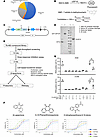
Ubiquitin-Specific Protease 18 (USP18) is a deISGylation enzyme and antineoplastic target. To develop USP18 inhibitors, an enzymatically active human recombinant USP18 protein was engineered suitable for high-throughput screening of ~80,000 chemical compounds. Three of them substantially inhibited USP18 enzymatic activity, with β-lapachone having prominent antineoplastic activity. Independent β-lapachone treatments of murine and human lung cancer cell lines statistically significantly reduced proliferation and increased apoptosis. Gain of USP18 expression antagonized these effects. β-Lapachone treatments statistically significantly repressed lung cancer xenograft growth. β-Lapachone increased reactive oxygen species (ROS), but antineoplastic effects occurred at dosages with negligible ROS production. ROS scavenger treatments did not rescue β-lapachone effects at these concentrations, consistent with an ROS-independent mechanism. IFN-Stimulated Response Element (ISRE) reporter assays following β-lapachone treatment activated this reporter. USP18 cotransfection antagonized this activity. β-Lapachone treatments increased global ISGylation. RNA-seq of lung cancer cells engineered with or without enhanced USP18 expression showed specific pathways affected by β-lapachone treatment. Proteomic analysis of these treated cells revealed known and new ISGylated proteins. In silico modeling identified a unique USP18 pocket where these USP18 inhibitors bind. Engineered mutation of this pocket disrupted β-lapachone activity. Taken together, β-lapachone is an antineoplastic tool compound useful for USP18 inhibitor development.
Authors
Blessing O. Ogunlade, Kevin N. Dalby, Samuel C. Okpechi, Eun Jeong Cho, Liliya Tyutyunyk-Massey, Zibo Chen, Xiuxia Liu, Joseph Ivanic, Brian Luke, Shyamal D. Desai, Yair Alfaro, Ashwini K. Devkota, Rae M. Sammons, Gilbert G. Privé, Xi Liu, Ethan Dmitrovsky
This file is in Adobe Acrobat (PDF) format. If you have not installed and configured the Adobe Acrobat Reader on your system.
Having trouble reading a PDF?
PDFs are designed to be printed out and read, but if you prefer to read them online, you may find it easier if you increase the view size to 125%.
Having trouble saving a PDF?
Many versions of the free Acrobat Reader do not allow Save. You must instead save the PDF from the JCI Online page you downloaded it from. PC users: Right-click on the Download link and choose the option that says something like "Save Link As...". Mac users should hold the mouse button down on the link to get these same options.
Having trouble printing a PDF?
- Try printing one page at a time or to a newer printer.
- Try saving the file to disk before printing rather than opening it "on the fly." This requires that you configure your browser to "Save" rather than "Launch Application" for the file type "application/pdf", and can usually be done in the "Helper Applications" options.
- Make sure you are using the latest version of Adobe's Acrobat Reader.


