
Abstract
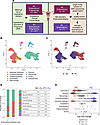
BACKGROUND In vitro fertilization (IVF) culminates in embryo transfer into a hormonally primed endometrium, often via a programmed cycle (PC) regimen postulated to influence hypertensive disorders of pregnancy (HDP) risk. We thus generated a single-cell atlas of PC endometrium to define cell type–specific differences relative to natural cycle (NC) endometrium and evaluated whether PC-associated modulation of the window of implantation (WOI) endometrium influences angiogenic balance in pregnancy.METHODS snRNA-seq of prospectively collected PC and NC WOI endometrium. An independent prospective cohort of 548 singleton pregnancies was separately analyzed for maternal serum angiogenic markers (soluble fms-like tyrosine kinase-1; placental growth factor) and HDP incidence in PC- versus NC-conceived pregnancies, adjusting for clinical confounders and IVF use.RESULTS Prominent transcriptomic differences were observed between PC (n = 7; 48,843 nuclei) and NC (n = 9; 44,230 nuclei) WOI endometrium, particularly in glandular epithelium (682 up- and 979 downregulated genes; Padj < 0.05) and stromal fibroblasts (108 up- and 168 downregulated). PC endometrium showed reduced uterine natural killer cell abundance, potentially from CXCL14 downregulation. Functional enrichment revealed downregulation of embryo implantation, angiogenesis, and extracellular matrix remodeling pathways in PC. Altered cell-cell signaling in decidualization, angiogenesis and inflammatory response were also observed. Despite these WOI perturbations, PC-conceived pregnancies were not associated with early gestational angiogenic imbalance or increased HDP risk.CONCLUSION PC endometrial preparation induced distinct cellular and signaling alterations in the WOI but was not associated with subsequent development of angiogenic imbalance or HDP, thereby underscoring the resilience and adaptability of the early maternal-fetal interface.TRIAL REGISTRATION ClinicalTrials.gov NCT03799107.FUNDING ABOG/AAOGF; NICHD-R01-HD084380; NCTRI-P50-HD055764; NIAMS-P30-AR070155.
Authors
David Huang, Emily Flynn, Brittany Davidson, Juan C. Irwin, Mohammad Naser, Ana Laura Almonte, Jennifer Qin, Yue Song, Fleurdeliza B. Rabara, Rebecca Wong, Lydia B. Zablotska, Mitchell P. Rosen, Torsten Wittmann, Gabriela K. Fragiadakis, Alexis J. Combes, Marina Sirota, Marcelle I. Cedars, Linda C. Giudice
This file is in Adobe Acrobat (PDF) format. If you have not installed and configured the Adobe Acrobat Reader on your system.
Having trouble reading a PDF?
PDFs are designed to be printed out and read, but if you prefer to read them online, you may find it easier if you increase the view size to 125%.
Having trouble saving a PDF?
Many versions of the free Acrobat Reader do not allow Save. You must instead save the PDF from the JCI Online page you downloaded it from. PC users: Right-click on the Download link and choose the option that says something like "Save Link As...". Mac users should hold the mouse button down on the link to get these same options.
Having trouble printing a PDF?
- Try printing one page at a time or to a newer printer.
- Try saving the file to disk before printing rather than opening it "on the fly." This requires that you configure your browser to "Save" rather than "Launch Application" for the file type "application/pdf", and can usually be done in the "Helper Applications" options.
- Make sure you are using the latest version of Adobe's Acrobat Reader.


