
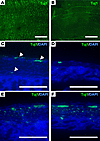
Abstract
Hirschsprung disease (HSCR) is a congenital intestinal disorder characterized by the absence of ganglia in the distal intestine. Despite surgical resection of the aganglionic intestine and pull-through surgery, patients with HSCR still experience bowel dysfunction, indicating that latent abnormalities may also exist in the proximal ganglionic intestine. To elucidate possible causes of postoperative bowel dysfunction in HSCR, we investigated differences in the proximal ganglionic intestine using an animal model of HSCR (Ednrb-null mice) and validated our findings in tissue from patients with HSCR. We found that the proximal ganglionic colon of HSCR mice exhibited greater stiffness and fibrosis than their WT littermates. Similarly, submucosal fibrosis was significantly greater in the proximal ganglionic intestine of patients with HSCR than in intestinal tissue from age- and site-matched controls. Furthermore, we observed dysregulated expression of extracellular matrix–related (ECM-related) genes in the proximal ganglionic intestine of HSCR mice compared with controls. We conclude that increased fibrosis, stiffness, and alterations in ECM composition may contribute to persistent dysfunction of the ganglionic intestine in HSCR. These findings add to the growing body of literature that describe abnormalities in the proximal ganglionic intestine of HSCR and suggest that HSCR is not limited to the aganglionic intestine alone.
Authors
Prisca C. Obidike, Britney A. Hsu, Chioma Moneme, Oluyinka O. Olutoye II, Walker D. Short, Mary Hui Li, Swathi Balaji, Yuwen Zhang, Sundeep G. Keswani, Lily S. Cheng
This file is in Adobe Acrobat (PDF) format. If you have not installed and configured the Adobe Acrobat Reader on your system.
Having trouble reading a PDF?
PDFs are designed to be printed out and read, but if you prefer to read them online, you may find it easier if you increase the view size to 125%.
Having trouble saving a PDF?
Many versions of the free Acrobat Reader do not allow Save. You must instead save the PDF from the JCI Online page you downloaded it from. PC users: Right-click on the Download link and choose the option that says something like "Save Link As...". Mac users should hold the mouse button down on the link to get these same options.
Having trouble printing a PDF?
- Try printing one page at a time or to a newer printer.
- Try saving the file to disk before printing rather than opening it "on the fly." This requires that you configure your browser to "Save" rather than "Launch Application" for the file type "application/pdf", and can usually be done in the "Helper Applications" options.
- Make sure you are using the latest version of Adobe's Acrobat Reader.


