
Abstract
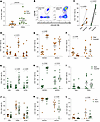
Latently infected cells persist in people living with HIV (PWH) despite suppressive antiretroviral therapy (ART) and evade immune clearance. “Shock and Kill” cure strategies are hampered by insufficient enhancement of targeted immune responses following latency reversal. We previously demonstrated that autologous Vδ2 T cells from PWH retain anti-HIV activity and can reduce CD4+ T cell reservoirs, although their use in cure approaches is limited due to their dual role as a viral reservoir. However, promising clinical data in oncology shows that their unique MHC-unrestricted antigen recognition affords potent on-target cytotoxicity in the absence of graft-versus-host disease when used as an allogeneic adoptive cell therapy modality. Here, we found expanded allogeneic Vδ2 T cells specifically eliminated HIV-infected CD4+ T cells and monocyte-derived macrophages (MDM), overcoming inherent resistance to killing by other cell types such as NK and CD8+ T cells. Notably, we demonstrated that allogeneic Vδ2 T cells recognized and eliminated the HIV-latent CD4+ T cell reservoir following latency reversal. Our study provides evidence for developing an allogeneic γδ T cell therapy for HIV cure and warrants preclinical investigation in combination approaches.
Authors
Brendan T. Mann, Marta Sanz, Alisha Chitrakar, Kayley Langlands, Marc Siegel, Natalia Soriano-Sarabia
This file is in Adobe Acrobat (PDF) format. If you have not installed and configured the Adobe Acrobat Reader on your system.
Having trouble reading a PDF?
PDFs are designed to be printed out and read, but if you prefer to read them online, you may find it easier if you increase the view size to 125%.
Having trouble saving a PDF?
Many versions of the free Acrobat Reader do not allow Save. You must instead save the PDF from the JCI Online page you downloaded it from. PC users: Right-click on the Download link and choose the option that says something like "Save Link As...". Mac users should hold the mouse button down on the link to get these same options.
Having trouble printing a PDF?
- Try printing one page at a time or to a newer printer.
- Try saving the file to disk before printing rather than opening it "on the fly." This requires that you configure your browser to "Save" rather than "Launch Application" for the file type "application/pdf", and can usually be done in the "Helper Applications" options.
- Make sure you are using the latest version of Adobe's Acrobat Reader.


