
Abstract
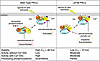
Spinocerebellar ataxia type 14 (SCA14) is an autosomal dominant neurodegenerative disease caused by mutations in the gene encoding protein kinase C γ (PKCγ), a Ca2+- and diacylglycerol-dependent Ser/Thr kinase dominantly expressed in cerebellar Purkinje cells. These mutations impair autoinhibitory constraints to increase the basal activity of the kinase, resulting in deficits in the cerebellum that are not observed upon simple deletion of the gene, and severe ataxia. To better understand the impact of aberrant PKCγ signaling in disease pathology, we developed a knockin murine model of the SCA14 mutation ΔF48 in PKCγ. This fully penetrant mutation is severe in humans and is mechanistically informative, as it has high basal activity but is unresponsive to agonist stimulation. Genetic, behavioral, and molecular testing revealed that ΔF48 PKCγ mice have ataxia-related phenotypes and an altered cerebellar phosphoproteome driven primarily by enhanced Ca2+/calmodulin-dependent kinase 2 signaling, effects that were more severe in male mice. Analysis of existing human data revealed that SCA14 has a significantly earlier age of onset for males compared with females. Data from this clinically relevant mutation suggested that enhanced basal activity of PKCγ is sufficient to cause ataxia and that treatment strategies to modulate aberrant PKCγ may be particularly beneficial in males.
Authors
Sarah A. Wolfe, Yuliang Ma, Tomer M. Yaron-Barir, Carly Chang, Caila A. Pilo, Majid Ghassemian, Amanda J. Roberts, Sang Ryeul Lee, Benjamin A. Henson, Kristen Jepsen, Jared L. Johnson, Lewis C. Cantley, Susan S. Taylor, George Gorrie, Alexandra C. Newton
This file is in Adobe Acrobat (PDF) format. If you have not installed and configured the Adobe Acrobat Reader on your system.
Having trouble reading a PDF?
PDFs are designed to be printed out and read, but if you prefer to read them online, you may find it easier if you increase the view size to 125%.
Having trouble saving a PDF?
Many versions of the free Acrobat Reader do not allow Save. You must instead save the PDF from the JCI Online page you downloaded it from. PC users: Right-click on the Download link and choose the option that says something like "Save Link As...". Mac users should hold the mouse button down on the link to get these same options.
Having trouble printing a PDF?
- Try printing one page at a time or to a newer printer.
- Try saving the file to disk before printing rather than opening it "on the fly." This requires that you configure your browser to "Save" rather than "Launch Application" for the file type "application/pdf", and can usually be done in the "Helper Applications" options.
- Make sure you are using the latest version of Adobe's Acrobat Reader.


